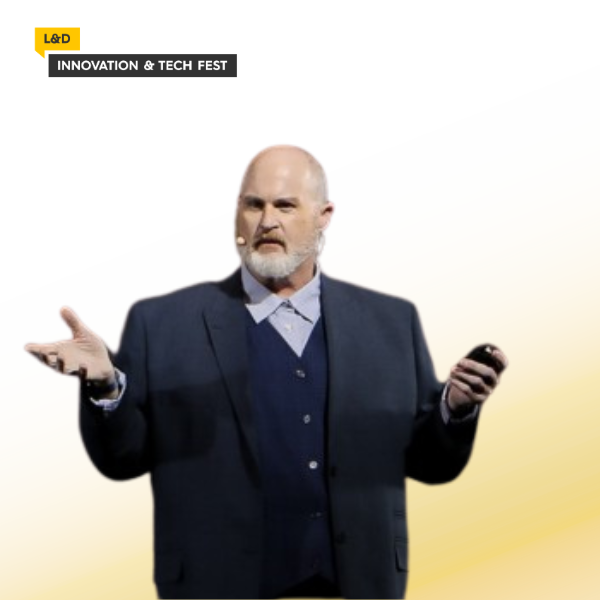
Darren Nerland (USA)

Position: Leadership & Workforce Transformation Thought Leader
Organization: Independent Contractor
Darren Nerland has spent 20+ years inside the complexity that most consultants only advise on. He has led learning, talent, and workforce strategy at organizations including Amazon, Microsoft, and the Gates Foundation, building systems that had to work at scale, under pressure, and across diverse populations. He helps CHROs, CLOs, and senior L&D leaders turn future-of-work signals into practical workforce strategies. His work sits at the intersection of leadership development, skills architecture, and Relational AI, an approach to AI that goes beyond prompting and builds toward real partnership. He does not believe leadership is a ladder. He believes it is navigation. And he builds the tools to prove it.

Session Overview

Designing the Workforce of the Future: From Foresight to Capability & Skills
Connecting strategy, workforce planning, and upskilling to future-critical capabilities.
Why this matters:
Most organizations still plan workforce needs by role and headcount, while strategy increasingly depends on capabilities that cut across functions and evolve quickly. HR is asked to anticipate future talent demands, L&D is expected to build new skills, and executives expect adaptability and performance, yet these efforts often operate in silos. The result is misaligned investment, capability blind spots, and slow internal response when the business shifts.
A skills-based organization creates a shared capability architecture that connects strategy, workforce planning, and targeted upskilling. It makes critical capabilities visible, exposes risk and overinvestment, and enables internal mobility based on skills rather than job titles. This is not about improving training programs. It is about building a workforce system designed for resilience and strategic agility.
Strategic Takeaways
  1. Reframe Workforce Planning Around Capability, Not Headcount: Shift from headcount forecasting to capability forecasting, identifying the future-critical capabilities required to execute strategy and make smarter build, buy, borrow, or automate decisions.
  2. Redesign the Organization Around Capability Portfolios: Move from job descriptions to clearly defined capability portfolios, applying a simple skills taxonomy that connects enterprise capabilities to core skill clusters and depth requirements.
  3. Replace Static Succession with Dynamic Skill Mobility: Transition from static succession planning to skill-based internal mobility, using capability visibility and skill adjacency to mobilize talent more quickly across roles and priorities.
  4. Align Upskilling to Strategic Capability Investment: Shift from generic upskilling to targeted capability investment, ensuring learning and development resources directly strengthen enterprise-critical capabilities rather than isolated activities.
Leading with Judgment, Clarity, and Velocity in an AI World: Turning AI into Strategic Advantage
Human judgment, system design, and performance in an AI-augmented world
Why this matters:
AI is no longer a future disruption. It is an active force inside decision-making, operations, and knowledge work. Yet most organizations are layering AI onto workflows designed for a pre-AI world. The result is either incremental efficiency or amplified confusion.
AI will magnify what already exists. Clear strategy becomes sharper. Poor alignment becomes louder. High-performing teams accelerate. Fragile cultures fracture. The differentiator is no longer access to information. It is leadership judgment, system design, and the ability to align human capability with intelligent tools.
The organizations that win will not be those with the most AI. They will be those with leaders who can design environments where human judgment, psychological safety, adaptability, and intelligent machines operate as one performance system.
Strategic Takeaways:
  1. Design Human–AI Operating Systems, Not Just Workflows: Shift from task automation thinking to system-level design that integrates AI tools, human capability, and decision rights. Understand how structure, incentives, and clarity determine whether AI drives leverage or noise.
  2. Elevate Judgment as the Leadership Differentiator: Move beyond information access to disciplined judgment. Distinguish data from insight, and insight from strategic action. Strengthen leaders’ ability to interpret AI outputs, challenge assumptions, and translate intelligence into performance impact.
  3. Build Strategic Advantage Through Safety and Adaptability: Recognize that physical and psychological safety, combined with skill adaptability, form the foundation for effective AI adoption. Create environments where experimentation is safe, learning velocity increases, and capability evolves alongside technology.
  4. Lead High-Performing Teams in an Augmented Environment: Redefine high performance in the context of AI. Align clarity of purpose, decision discipline, trust, and human strengths such as empathy, creativity, and systems thinking to unlock sustained performance and measurable business impact.

Buy Tickets

Team Tickets (Minimum of 5)

R11,995

P/P – PRICE EXCL. VAT

Individual Ticket (1 Ticket)

R13,995

P/P – PRICE EXCL. VAT

Alternatively, please email sales@eventfulpeople.com for quote, invoice or any queries and we’ll be glad to assist.

Subscribe to our mailing list

"*" indicates required fields

This field is for validation purposes and should be left unchanged.

Download Agenda

Complete the fields below in order to access our Agenda.

Download the agenda

Other Events of Interest

Please fill out the form to view the Conference Agenda pdf

Community Snapshot

Complete the fields below in order to access our community snapshots.

This field is for validation purposes and should be left unchanged.

Community Snapshot

Complete the fields below in order to access our community snapshots.

This field is for validation purposes and should be left unchanged.

Find out more about Planner’s School

Find out more about Planner’s School

Darren Nerland has spent 20+ years inside the complexity that most consultants only advise on. He has led learning, talent, and workforce strategy at organizations including Amazon, Microsoft, and the Gates Foundation, building systems that had to work at scale, under pressure, and across diverse populations. He helps CHROs, CLOs, and senior L&D leaders turn future-of-work signals into practical workforce strategies. His work sits at the intersection of leadership development, skills architecture, and Relational AI, an approach to AI that goes beyond prompting and builds toward real partnership. He does not believe leadership is a ladder. He believes it is navigation. And he builds the tools to prove it.